Tuesday, February 19, 2013

Recent close encounters in Active Pass

Remember back in 2007 when the Morfitt Report criticized BC Ferries for having two large ships pass each other in the middle of Active Pass?

Go here for the media-trimmed version of things.
"A collision in Active Pass could have catastrophic results -- on the travelling public, on the company, and on the economy of Vancouver Island,'' Morfitt wrote.
"BC Ferries should, as part of a formalized risk management process, undertake an assessment of the degree of risk associated with the current practice of allowing BC Ferries' vessels to transit Active Pass simultaneously.''
Contributing to the risk "is the situation where two vessels are making the transit at a combined closing speed of 30 to 35 knots, with two 90-plus degree turns, and little room to manoeuvre if either ship has a major problem,'' Morfitt wrote.
Potential loss of steering control or propulsion, electrical blackout or human error all pose risks of these ships colliding with each other or smaller craft.
That was all in reference to two large ships, Spirit class vessels, with twin engines, twin rudders and bow thrusters. Things have changed.

BC Ferries now has two double-enders passing each other in Active Pass. The Super-C class is not as maneuverable as the Spirit class and has encountered some serious problems with the "forward" propeller control.

But that's not what this is about. Morfitt said, back in 2007, that BC Ferries use of Active Pass created a significant risk. BC Ferries responded with a risk assessment that essentially said they were handling things quite nicely  - thank you.

However, not all is well in Active Pass. In January 2013, BC Ferries had at least two dangerous close-quarters incidents in Active Pass and you, traveller, have heard nothing about them.


Monday, April 2, 2012

54 North and the plan to nowhere (Part III)

It was important to wait until the release of the federal budget to determine what should be discussed. As I pointed out in a previous submission, only immediate action by the federal government could prepare the North and Central coast of British Columbia for a massive increase in marine traffic and especially the increased numbers of large vessels moving petroleum, condensate, liquified natural gas and product.


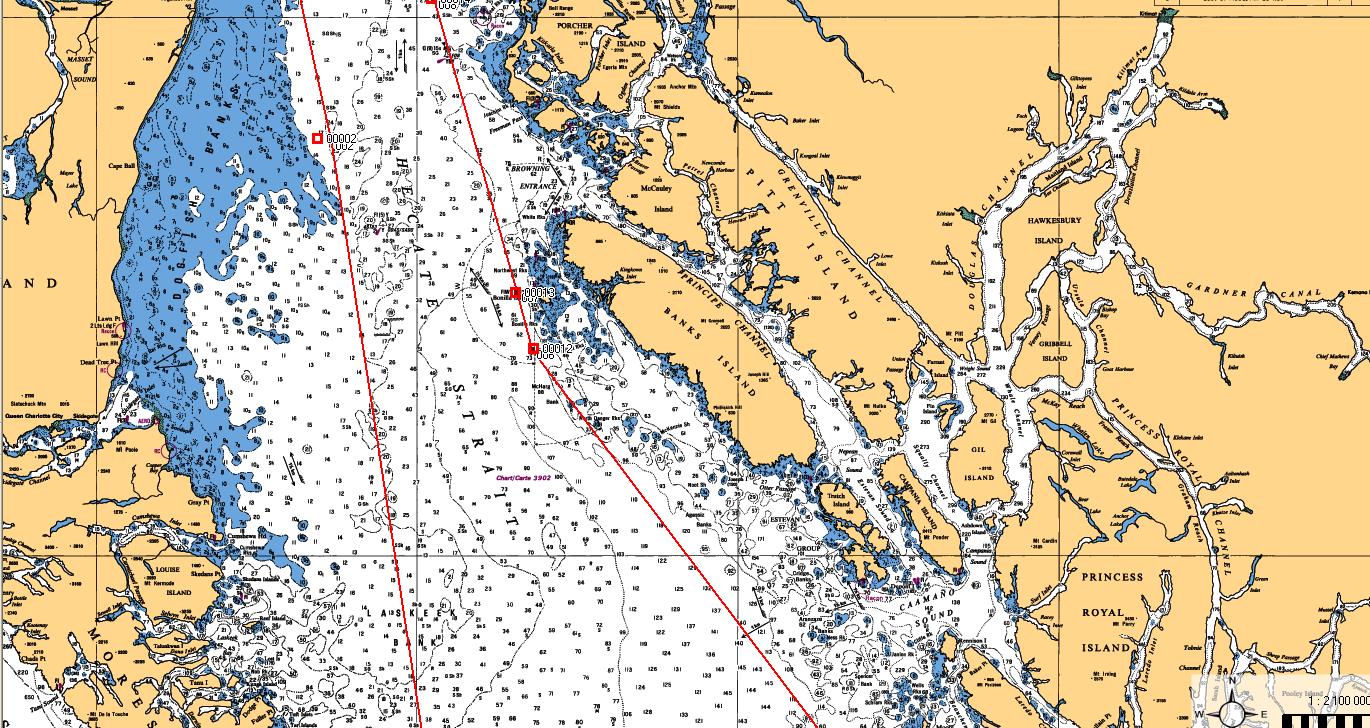
The above chart (click to enlarge) is an extract of the small scale CHS navigation chart for the Queen Charlotte Islands, Central and North coast of BC and Hecate Strait. The red lines bordering the coast of each landmass indicates the limits of pilotage waters in which large ships must have a licensed BC Coast Pilot onboard. That is to say, when in Hecate Strait facing the mainland of BC, pilotage waters are to the east of the easternmost red line. Facing the Queen Charlotte Islands, pilotage waters are to the west of the westernmost red line.

Unlike the waters around southern Vancouver Island and the south BC coast generally, none of the sea areas, inlets, arms, passages or any other tidal waters area or port have coastal radar coverage intended to monitor or aid marine traffic. In fact, there is not even a traffic separation scheme intended to prevent the interaction of ships in the restricted waters of the inside passage.

Let's now take a closer look at a particular area in question.


This is simply a larger scale extract of the Hecate Strait CHS chart. (Click to enlarge). You can see the type of difficulty a ship approaching the coast would encounter. For one thing Hecate Strait is world renown for being one nasty stretch of water and boarding a pilot during periods when gale to hurricane force winds are ripping up the place will be anywhere from extremely difficult to life threatening. Additionally, in periods of high winds and high seas, many of the ships expected to approach the coast will encounter a problem developing enough propulsion power to avoid being pushed further shoreward and into some very dangerous shoal ground. 


The above is an example of the actual surface weather on 2 April 2012: A mid-latitude depression with an incredible 958 millibar low pressure centre just off the west coast of the Queen Charlotte Islands. Forecast winds north of Vancouver Island and into Hecate Strait were South East at Hurricane Force throughout the morning with seas exceeding 8 meters. With a surface picture like the one above it would constitute a herculean effort for an inbound ship in ballast to maintain adequate control to reach shelter and safe waters. An outbound laden vessel, depending on its size, could easily be set to the north and, if it was exiting Caamano Sound, find itself slamming headlong into the southern extremities of the Queen Charlotte Islands. 

There has been much discussion that, in the absence of suitable shore-based radar, the current Automatic Information System (AIS) will provide accurate data on the position, course and speed of any ship in the approaches to either Browning Entrance or Caamano Sound. That would be a temporary fix only. AIS, as useful as it is, is not accurate real-time tracking. Further, it has serious flaws, not the least of which is that vessels often drop off the AIS plot depending on where they are in relation to LOS blocking land masses.


The above is an AIS collection shot. Remarkably, what is missing from this capture is the traffic that was actually present in the inside passages of the central BC coast (3 vessels) and one making a transit across Hecate Strait. 

None of this is to say that the Northern Gateway pipeline terminal to Kitimat should or should not proceed. That is not the purpose for now. 

It is to point out that the means to ensure complete tanker safety under pilotage and secure vessel traffic management do not yet exist and the recent federal budget is less than comforting. 

As pointed out in a previous submission the federal government had this one opportunity to fund and start implementing the required changes to the BC north and central coast to bring shipping safety to a level which will satisfy the need to increase safety and oversight of a massive increase in heavy ship traffic. 

The federal government not only did not do anything, it actually cut the budget of the one department responsible for upgrading the vessel traffic services in the critical area. As has been pointed out previously, Enbridge which originally stated that they would be installing new VTS radar and nav aids has made it clear that they have no intention of bearing the cost and are negotiating with the federal government.

None of this is aided by the offerings of Enbridge. This disingenuous bit of propaganda needs to be addressed.

At the link above, Enbridge provides a picture of a chemical tanker arriving in Kitimat on 16 March 2012, and then goes on to provide numbers which demonstrate a continuous flow of tankers between 1982 and 2009, and why don't all you environmental activists just chew on all those wonderful facts. 

Well, since I commanded a chemical tanker into the port of Kitimat, I suppose I should clear up some of the fog which the Enbridge spin-merchant has dumped.

Chemical tankers are considerably smaller than the ships Enbridge is proposing to bring to Kitimat. Most chemical tankers max out at about 40,000 DWT.

Enbridge is proposing the following size ships:
AFRAMAX - 120,000 DWT
SUEZMAX - 200,000 DWT
VLCC - 315,000 DWT (eight times the size of a large chemical tanker)

Enbridge, in playing with their numbers (which are accurate) did not provide the annual average numbers. Between 1982 and 2009 there was actually an average of 55 transits of Douglas Channel by tankers annually - somewhere around one ship per week. 

Enbridge plans to increase that to about 220 annually, or about 4 to 5 ships per week. And the ships they plan on introducing will be anywhere from three times to eight times the size of existing ships. 

Another point, conveniently side-stepped, is that with three LNG terminals in the works at Kitimat, the traffic into Kitimat will actually increase by much more than 220 ships per year. Somewhere on the scale of 400 is much more likely once all terminals are running at capacity.

Enbridge tries to downplay the cargo by suggesting that the current shipping traffic is carrying petroleum products, therefore they are not introducing anything new. Except that they are. 

Current and past product into and out of Kitimat was mostly methanol and condensate. Petroleum products they are, but they are actually highly evaporative liquid by-products of natural gas. A spill would cause some immediate damage to be sure, but it would evaporate in short order and there would be little in the way of a persistent effect. 

What Enbridge is proposing, (and what they are attempting to favourably compare to a highly evaporative liquid), is actually a liquefied, unrefined, thick crude oil, much more akin to tar than it is to methanol. A spill of that type of product would create lasting devastation for decades - if you could ever get it cleaned up at all. 

That brings up the cost of a clean-up, should it ever be required. There is a long and winding road to travel to get both the funding and the resources to deal with a spill. Insurance is a tricky game in the shipping world. 

We'll take a look at that next time. 


Wednesday, March 7, 2012

54 North and the plan to nowhere (Part II)

Transport Canada claims to have no regulatory problems, at all, with the Enbridge Northern Gateway proposal to bring AFRAMAX, SuezMax and VLCC sized ships into BC coastal waters from the pelagic Pacific.TC submitted their assessment to the joint regulatory panel with no apparent input from sources outside the information provided by the proponent (Enbridge).

Before anyone gets too carried away, what TC actually approved was the proposed plan. In short, TC has no problem with the routes and the route safety proposals offered by Enbridge, provided everything Enbridge is stating in their proposal is actually put into action. That would include markedly improved vessel traffic management, escort and pilot service expansion, spill containment guarantees and stringent terminal safety requirements.

The first, (and most obvious), problem with saying "no problem" is that none of those things actually exist. Some of them require substantial upgrading. Vessel Traffic Services alone are already inadequate north of Cape Caution and, despite initial assurances from Enbridge, to bring them to a condition to properly monitor, assess and manage a high volume of deep-sea ships into constricted waters will require Canadian government involvement on the scale of hundreds of millions of dollars.

The second, (and perhaps more significant), problem is the guidelines on which Transport Canada based their approval.

Transport Canada and Enbridge have engaged in a review of the proposal using the guidance and system checklists in TP743E TERMPOL Review Process (TRP). Given that there is currently little to physically review, any assessment must be non-binding.

Starting with the document itself, a problem arises. The latest iteration of TP743E TERMPOL is dated 2001. That precedes the Canada Shipping Act 2001 by some six years (which did not come into force until 2007). The eleven-year old document is so out-of-date that it doesn't even mention current-day navigation technology, much of which is considered mandatory by the International Maritime Organization.

Equipment such as fitted Automatic Identification Systems (AIS) and Electronic Chart Display and Information Systems (ECDIS) were still in development when TERMPOL was last issued. As a result, such systems are not even mentioned in the review process.

Nautical chart standards have so radically changed in the past decade that TERMPOL does not demand that the latest version of electronic navigation charts, meeting the International Hydrographic Organization S-57 standard, be carried by ships of any tonnage entering Canadian waters.

Perhaps that's just as well since there is no chart meeting the IHO S-57 standard for the critical stretch of Douglas Channel to Kitimat Arm. The only form of electronic display chart available for that area is a raster chart which is little more than a scanned bitmat image of an existing paper chart. While they are accurate enough for small craft, they fall well short of the standard expected in a large merchant vessel.

While many people are trumpeting the TERMPOL review of the Enbridge proposal as some form of regulatory victory, such is simply not the case. A TRP is a highly limited process and the following needs to be understood:
1.4.1 The TRP is not a regulatory instrument. Its provisions, therefore are not mandatory. The TRP’s criteria, however, are used by TCMS in determining the need for making or revising specific regulations, or for implementing special precautionary measures that may affect a ship’s operation within a particular marine terminal system or transshipment site.

1.4.2 Any report issued by a TERMPOL Review Committee (TRP) should neither be interpreted as a statement of government policy, nor should it be inferred that the government endorses the report in whole, or in part. The report reflects only the judgments of the departmental representatives who reviewed the proposal and prepared the report. Consequently, the conclusions and recommendations presented in a TERMPOL report are not binding on any department, agency, group or individual. Implementation of any recommendation, however, is the prerogative of applicable departmental executives performing regulatory functions or of the proponent, as appropriate.
In short, what that says is that Transport Canada Marine Safety has looked at a very narrow aspect of the entire Enbridge marine proposal. There is still a long row to hoe.
It must be understood, however, that DFO CCG and TCMS regulatory roles are separate and distinct from their roles in the TRP which is essentially a data and operational review process. The conclusions and recommendations contained in a TERMPOL report do not relieve a proponent from an obligation to fully comply with all applicable legislative and regulatory requirements promulgated, and as amended from time to time, by the various federal and provincial statutes and regulations which apply to shipping safety and to the protection of the environment. These Acts include but are not limited to:
  • the Canada Shipping Act;
  • the Navigable Waters Protection Act;
  • the Arctic Waters Protection Act;
  • the Canadian Environmental Protection Act;
  • the Canadian Environmental Assessment Act;
  • the Transportation of Dangerous Goods Act;
  • the Fisheries Act;
  • the Oceans Act; and
  • the Canada Marine Act. 
And no one has even touched on those yet.

Hopefully we can take a look at the regulatory holes, (some of which are large enough to sail a VLCC through), in a future offering.

Sunday, February 19, 2012

Two ferry prangs in one week

You might want to file this under, "It can happen to anybody".

The Caledonian MacBrayne ship Isle of Mull made an extremely hard landing at Oban when it was picked up by a 60 knot gust of wind during her approach.
A CalMac spokesman said: "The MV Isles of Mull came into contact with the pier in Oban as a result of being struck by a 60 knots (70 mph) gust of wind on her approach.

"Her bow visor and the gangway were both damaged as a result. No-one was injured.

"A detailed assessment of the damage will be carried out and once complete we will be able to establish how long repairs are likely to take."
Which topped off a bad week for hard landings at CalMac. Another one of their major ships, Caledonian Isles, had a similar problem on Tuesday evening as she was making the approach to Ardrossan.
A CalMac spokesman said: "As the MV Caledonian Isles was entering Ardrossan Harbour yesterday evening, the weather deteriorated suddenly and a 55mph (force 9) gust of wind blew her onto the Winton pier.

"She was tied up while the Master waited for the wind to drop to allow her to berth, which she did about an hour later, and passengers and vehicles were able to disembark. No-one was injured.

"In the interest of safety the vessel is required to enter dock for inspection and repairs, although damage is not believed to be serious.
Caledonian MacBrayne is a Scottish state-owned ferry company and it is not without its own share of problems.

Sunday, February 12, 2012

54 North and the plan to nowhere (Part 1)

The proposed Enbridge Northern Gateway pipeline project has already raised more than eyebrows and the hearings have only really just begun. Enbridge has provided assurance after assurance that the whole show will be completely safe including the movement of ships through BC's  north coast access to Kitimat arm at the head of Douglas Channel.

I've made the trip Enbridge is suggesting is completely safe, in a chemical tanker, more than a few times. And given that my ship was considerably smaller than what Enbridge is proposing even my eyebrows started lifting.

Stephen Harper's Feb 2012 visit to China saw him pumping hard to promote the Northern Gateway project. Listening to him it sounded like a fait d'accompli and the regulatory review currently underway is little more than a time-consuming annoyance.

This is the same Stephen Harper who has taken a rake to the funding of federal departments and has forced them to either reduce or cut operations, including the Canadian Coast Guard and DFO, the increased presence of which will be critical to the prevention of any future disaster in light of the enormous expansion in large tanker traffic being proposed.

Enbridge has offered public assurances of a high standard of maritime safety in a summary here. Many of the statements they offer are motherhood:
All vessels entering Kitimat Marine Terminal will be modern and double-hulled
As if they couldn't be? That is a standard of the International Maritime Organization. Enbridge is not doing anything.
Operational safety limits will be established to cover visibility, wind and sea conditions
Again, not something over which Enbridge has any say. Such limits are established by international rules and Canadian government regulation. Not to mention the standard practice of seafarers. Since Enbridge does not appear to be building a fleet of their own to transport bulk bitumen they will have no additional control over shipping.
The escort tugs will have extensive first response capabilities to provide immediate assistance if required (available to any ship in distress)
Good. That bit in brackets however, is not something Enbridge is doing to increase their goodness. It is the statutory obligation of all mariners, when able, to come to the aid of any vessel in distress. This little part of the Enbridge "plan" is written in law.
Northern Gateway will install an advanced radar system to cover important route sections to provide guidance to pilots and all marine traffic on the Northwest coast
Will they now?  On 16 January 2012, in response to a question posted on the Enbridge website, they said this:

Northern Gateway has had preliminary discussions with the Department of Fisheries and Oceans, Canadian Coast Guard to assess how future additions to aids to navigation and the introduction of land-based radar coverage to the north coast may be paid for, constructed and maintained.

That doesn't sound definitive at all. It sounds like a plan to develop a plan. We'll get back to that a little later on.
Additional navigational aids will be installed, such as navigation beacons, buoys and lights throughout the confined channel area
Given that this is a DFO/Canadian Coast Guard responsibility the question now rises: who is expected to pay for all these new nav aids? More on that later, too.
Prior to arrival in Canadian waters, all vessels will be vetted by independent, third-party agencies and will be required to meet Northern Gateway's safety and environmental standards
How very nebulous. In further statements Enbridge introduces a "Tanker Acceptance Program". This is an industry standard and is in place in every major liquid cargo transfer terminal in the world. An old tanker master would look at this statement and immediately think SIRE program from the Oil Companies International Marine Forum. One would expect that Enbridge would be chin deep in the OCIMF library learning how to implement a TAP and develop "best practices" for the safety and environmental standards they are suggesting.

Enbridge, however, is not a member

Vessel speed will be reduced in the marine channels to between 8 and 12 knots
Which is one of those kinds of statements that dismisses the reality of conditions. Given the length of the transit and the time involved every ship, in both directions, will encounter changing conditions such as a tide change. Given the range of tide in Douglas Channel, for example (in the 6 meter range), that means a period of maximum flood or ebb currents. The speed over the ground will differ from the speed rung on. At times ships will be carrying revs for more than 12 knots just to maintain that speed. Laden outbound tankers will take time to get up to speed and once there will have a long reach if there is a requirement to slow. The speed of any vessel under pilotage however, may well be determined by the pilot. Ships under escort in Haro Strait and Boundary Passage are not permitted to exceed 10 knots - ever. How does Enbridge propose to see even larger ships permitted to achieve 12 knots when current rules existing in southern waters do not allow it?

All tankers visiting the Kitimat Marine Terminal will be safely guided by certified marine pilots
One would hope so, since that's the law. I have every confidence in BC Coast Pilots. Recent comments from the president of BC Coast Pilots Ltd. suggested that there would be no problem meeting the demand of increased tanker traffic. I will wonder, until the first transfer has happened, how pilots will join the ship outside the entrance to Caamano Sound in gale or storm force winds. One of the items out of the marine safety video that was interesting is that every ship will have two pilots thus providing the bridge with two more sets of independent eyes.

No.

The requirement for two pilots has to do with watchkeeping needs. The standard practice is that there is always one pilot on the bridge while the other one is resting. On occasion there is a mandatory requirement for two pilots on the bridge under pilotage rules set by the Pacific Pilotage Authority but no such rule exists outside Haro Strait and Boundary Pass at southern Vancouver Island.

At about this point one has to shift over to the marine safety fact sheet to get more information.
All laden tankers in the CCAA will be accompanied by one tug tethered (attached) to the tanker, and a second tug in close escort. Ballasted tankers within the CCAA and all tankers (laden and ballasted) travelling between the pilot boarding stations and the CCAA will be accompanied by one close escort tug.
The "CCAA" is an abbreviation for the Confined Channel Assessment Area. That isn't terribly clear on the Northern Gateway public website. Now, as to the escort tugs, let's face one simple fact: there is no legislation regarding escort tugs. Rules governing escort tugs in the waters around southern Vancouver Island come from the Pacific Pilotage Authority - not Transport Canada. And you would be hard pressed to find a copy of any such rules unless you knew where to look. Further, there are several things necessary to make an escort tug useful. There needs to be tanker/tug matching. An escort manual needs to be developed and extensive crew training undertaken. I'll have more on this subject in a future post.
Tankers will be subject to regular Port State inspections by Transport Canada
As for any foreign-flagged vessel of any type. This is not an Enbridge initiative - it is Canadian law and international maritime convention. The problem here, however, is Transport Canada. Port State Control inspections are anything but transparent and Transport Canada will not make public the result of any inspection without a Freedom of Information Request. Given that the seaworthiness of foreign-flagged vessels in Canadian waters is a matter of public interest in this country, and particularly where it applies to something like a Very Large Crude Carrier (Supertanker), Transport Canada's secrecy around such inspections is an abomination.

Earlier I pointed out that Enbridge stated that they would install land-based radar systems to facilitate traffic management. Since that appeared they have subsequently responded that they were in discussions with DFO and Coast Guard as to who would be funding, constructing and maintaining such a system. In the response they added this:

It is the responsibility of the Canadian Coast Guard, Marine Communications and Traffic Services (MCTS) to monitor traffic in Canadian waters via radio call-in and the newly implemented Automatic Identification System (“AIS”). The introduction of land-based radar with the support of Northern Gateway and proponents of other shipping projects would enhance the ability of MCTS to verify AIS and radio call in data. 
Right, because there is no marine traffic radar coverage on the north and central BC coast. None. The Marine Communications and Traffic Services of the Canadian Coast Guard has been subject to the same budget cutting measures as all other federal departments. Far from being ready to deal with increased vessel traffic involving ships of up to 320,000 DW tonnes, the Coast Guard is already under stress and the MCTS system has undergone staffing cutbacks.

Enbridge, who originally trumpeted that they would install radar is now appearing to waffle. And they're quite correct - there are other shipping projects for exactly the same area which will see a tripling of traffic into Kitimat. In fact, there are three of them.

If Stephen Harper is such a proponent of the Northern Gateway project and demanding it be built, despite any objections, he'd better be prepared to put his money on the table. The entire central and northern BC vessel traffic management system is need of attention now. If the upcoming federal budget fails to address the requirement to increase vessel safety on a huge scale it is a demonstration that the Harper government is not terribly serious about the Enbridge proposal or it is ignorant of the inherent risks or it just doesn't care. If a complete overhaul of the northern BC vessel traffic system doesn't begin within the next few months, nothing will be ready when the first big honkin' tanker shows up.


There's more, but that should be enough to start you thinking. Part two later.


Thursday, February 9, 2012

A picture that might add to those words from BC Ferries

So, the Queen of Burnaby, fresh out of refit, needs a drydock in a big way.
"Our engineers have determined that the problem with the Queen of Burnaby is in the propeller hub, and that means we do have to drydock the ship in order to facilitate those repairs," said BC Ferries spokesperson Deborah Marshall.
The average ferry user could be excused for believing the problem described by Marshall is minor. Until you look at this.
That complex looking gizmo, the whole thing, is a cut-away view of a ship's propeller hub.

Ms Marshall is being truthful but perhaps didn't leave those reading her words with the correct impression. The Queen of Burnanby left refit and was put back into service with that critical mechanism not functioning properly.

I'll be watching here.

Friday, January 27, 2012

BC Ferry Commissioner Regulatory Review and a single burning hole

I've flipped through the BC Ferry Commissioner's Regulatory Review with some interest. I'll withhold comment for now on a majority of it, although I will suggest that many of the recommendations are a long time coming.

What grabbed me instantly, however, was the graph on page 18 of the report. From 2004 to 2011 the cost of maintenance has been virtually unchanged. That, in an environment where inflation has been driving costs up at a little over 2.3 percent per year.

If BC Ferries was carrying out the same level of fleet and terminal maintenance today that they were before they were flipped over to a profit model the cost of maintenance should have increased. Even if there were efficiencies, it would have been impossible to maintain ships to a high standard of reliability and safety without a scaled increase in maintenance costs.

The first thing to go when a shipping company cheaps out on maintenance is quality control. Inspection falls by the wayside. Small things go unnoticed. Pins are left out and nuts are not torqued down.