My good friend and colleague was asked by a journalist for a comment on the Joe Oliver/Denis Lebel news conference held last week in Vancouver. I have to admit, listening to them left me feeling that they had very little respect for the people they represent. So Dave produced this as his comment. Unedited:
I promised Laila Yuile
that I would give her my take on the propaganda offered by investment
banker, Joe Oliver, currently the Minister of Natural Resources in
Harper's government.
Before I go on, I think you should first take a look at Chris Montgomery's
maritime blog where she makes one very solid point - new rules mean
nothing if they are enforced with the same vigour as the ones currently
in place. Transport Canada and other agencies involved in maritime
safety in Canada have been nothing, if not pitiful, in the pursuit of
regulatory stringency. Further, there is an undercurrent of "big bucks
gets the nod" when it comes to exemptions and relaxation of codified
regulations.
Gary Mason
also weighed in, suggesting that no amount of regulatory change or
stiffening will change what is likely to become known as the "failed
Northern Gateway pipeline". Maybe so, but there is this consistent
attempt to conflate the overland pipeline issue with the maritime
shipping concern. Even Enbridge links the two when, in fact, (and by
their own admission), they are distinctly separate items.
In
preparation for the roll-out of Oliver's little speech in front of
Vancouver Harbour, Transport Canada went to work and posted two items on
tanker safety in January of this year. It worth taking note of this and this. It's also worth taking note of the things Oliver said he would be changing.
An expert panel.
As Chris Montgomery pointed out, the chairman appointed is likely as
good as we're going to get. It certainly could have been worse. The
other two "experts" are not professional seafarers. I would like to hear
what, precisely, they are "expert" in dealing with. Not that it
matters. Harper's history in dealing with "experts" is to dismiss or
ignore anything they have to say and, if they go public with information
inconvenient to the Harper agenda, to smear them.
The two pilot rule.
This is not new. This already exists for laden tankers in BC coast
waters making the transit from Vancouver harbour to the Victoria pilot
station. Once both pilots have been disembarked at the Victoria
waterfront there is nothing, save a good passage plan and precise
execution, to prevent a foreign-flagged tanker, laden with diluted
bitumen from the Kinder-Morgan pipeline, from careening into Race Rocks,
Sherringham Point, or some other prominotory not in the current
vocabulary of Joe Oliver or Denis Lebel. Likewise, the trip out of
Douglas Channel would involve disembarking pilots at the limits of
mandatory pilotage and releasing the escort tugs wherein a
foreign-flagged ship finds itself in Hecate Strait facing the Queen
Charlotte Islands in some of the worst weather on the planet.
Increased tanker inspections.
Nice try. The last federal budget and its dodgy implementation bill
plundered Transport Canada of inspectors. The truth is, unless there is
an infusion of money and highly-skilled people into Transport Canada
increased inspection frequency will either be impossible or it will come
at the expense of Port State Control inspections of other cargo ship
types, all of which can be just as dangerous as a crude oil tanker. The
emphasis on "double hulls" is ludicrous. Tankers without double hulls
are already forbidden entry into North American ports. Notwithstanding,
double-hulls have developed some of their own problems which may make
the whole effort quite pointless.
Increase in the National Aerial Surveillance Program to monitor shipping.
Who are these two trying to kid? It's a great program to gather
intelligence and to spot pollution once it's already happened but it
won't for one second prevent an oil spill due to a ship running aground,
breaking up in heavy weather, or becoming involved in a collision. Keep
in mind that with budget cuts to the Canadian Forces, the RCAF has
reduced operations tempo and a good deal of the NASP was conducted by
Aurora and Arcturus long-range maritime patrol aircraft carrying out
sovereignty flights. Those are happening less often which means the
Oliver/Lebel dog and pony show is in fact nothing but numbers
manipulation.
Scientific research on non-conventional petroleum products like bitumen.
Well now, a lot of that research has already been done. Right up to the
point where the Harper government cut the staff of the research group
from 45 to 15. The government has the research of the group led by Merv Fingas
but the Harper government dismissed it - not convenient for the
narrative to which they adhere. So, is Oliver planning on listening to
qualified chemists, physicists and oceanographers or are they going to
buy into the opinions of Enbridge's hired biologist?
More ports, including Kitimat, designated for traffic control measures.
OK. So there will be traffic separation schemes. Traffic control from
Vessel Traffic Service stations is advisory. The truth is, unless there
is a huge amount of money spent on shore based radar covering the entire
inside passage, safety is not going to be enhanced. Current VTS on the
central coast relies on ships accurately providing their position at
check-in points and estimating the time of arrival at the next one. The
VTS station is blind. Reliance on automated information systems
providing a ship's course, speed and position is foolhardy. Such systems
are time-late and do not present a current surface picture.
Modern navigation systems and modified aids to navigation.
That's nice. It's also not new. Canada was well behind other countries
in producing digital charts to the S-57 IHO standard. This was
particularly the case with Douglas Channel where charts did not meet the
standard for electronic chart display and information systems. That's
being corrected so how this is a new initiative is something of a
mystery. As far as requiring arriving ships to possess the digital
technology, they already do. The addition of the necessary buoys,
lights, etc. to ensure the route is properly marked is not new; The fact that the Canadian Coast Guard is now going to have to install them is.
Up to this point, Enbridge was going to be required to pay for upgrades
to nav aids in Douglas Channel. Must be nice to have your old banker
buddies in a cabinet chair.
The amendments to oil terminal safety regulations are
so long overdue as to be laughable. TERMPOL is out of date by over a
decade. Requiring terminals to submit spill plans as a regulatory
requirement has been asked of this government since it came to office.
They have, up to now, done nothing. Administrative monetary penalties
are a good start but they are far too low for the likes of an oil
terminal which could do permanent environmental damage in a matter of
hours.
An important point here is that this is not about
any pipeline. This is about shipping. While there is certainly a
connection, keep very much in mind that once the ship has left the
terminal, no matter what outfits like Enbridge and Kinder-Morgan say
now, they are no longer the responsible party and they will wash their
hands of any involvement should a tanker hit the rocks.
That
brings up another issue. Unless something radical happens, every ship
transporting DilBit will be foreign-flagged. Every one. Canada has no
significant foreign-going tanker fleet. That, whether the likes of
Oliver or Lebel admit it or not, increases the risk. It would be a
straight-forward matter to do what other countries have done and require
that at least 40 percent of shipments be made in Canadian-flagged
vessels. That would require that outfits like Enbridge and
Kinder-Morgan, in order to move their product, become involved beyond
the terminal and pay much closer attention to the safety of the route.
It would be much more effective if Transport Canada was carrying out
Flag-State Control instead of Port-State Control. None of that will
happen, of course, and the likes of a propagandist banker like Oliver
will see that it never does.
Then of course, there's this.
Really, an "uncharted" sandbar? Maybe stick to deeper water next time.
And there are still reports out there that the spill response vessel had
a close-quarters situation with a BC Ferry. Not something which
inspires confidence.
Saturday, March 23, 2013


Tuesday, February 19, 2013
Recent close encounters in Active Pass
Remember back in 2007 when the Morfitt Report criticized BC Ferries for having two large ships pass each other in the middle of Active Pass?
Go here for the media-trimmed version of things.
BC Ferries now has two double-enders passing each other in Active Pass. The Super-C class is not as maneuverable as the Spirit class and has encountered some serious problems with the "forward" propeller control.
But that's not what this is about. Morfitt said, back in 2007, that BC Ferries use of Active Pass created a significant risk. BC Ferries responded with a risk assessment that essentially said they were handling things quite nicely - thank you.
However, not all is well in Active Pass. In January 2013, BC Ferries had at least two dangerous close-quarters incidents in Active Pass and you, traveller, have heard nothing about them.
Go here for the media-trimmed version of things.
"A collision in Active Pass could have catastrophic results -- on the travelling public, on the company, and on the economy of Vancouver Island,'' Morfitt wrote.That was all in reference to two large ships, Spirit class vessels, with twin engines, twin rudders and bow thrusters. Things have changed.
"BC Ferries should, as part of a formalized risk management process, undertake an assessment of the degree of risk associated with the current practice of allowing BC Ferries' vessels to transit Active Pass simultaneously.''
Contributing to the risk "is the situation where two vessels are making the transit at a combined closing speed of 30 to 35 knots, with two 90-plus degree turns, and little room to manoeuvre if either ship has a major problem,'' Morfitt wrote.
Potential loss of steering control or propulsion, electrical blackout or human error all pose risks of these ships colliding with each other or smaller craft.
BC Ferries now has two double-enders passing each other in Active Pass. The Super-C class is not as maneuverable as the Spirit class and has encountered some serious problems with the "forward" propeller control.
But that's not what this is about. Morfitt said, back in 2007, that BC Ferries use of Active Pass created a significant risk. BC Ferries responded with a risk assessment that essentially said they were handling things quite nicely - thank you.
However, not all is well in Active Pass. In January 2013, BC Ferries had at least two dangerous close-quarters incidents in Active Pass and you, traveller, have heard nothing about them.
Monday, April 2, 2012
54 North and the plan to nowhere (Part III)
It was important to wait until the release of the federal budget to determine what should be discussed. As I pointed out in a previous submission, only immediate action by the federal government could prepare the North and Central coast of British Columbia for a massive increase in marine traffic and especially the increased numbers of large vessels moving petroleum, condensate, liquified natural gas and product.


The above chart (click to enlarge) is an extract of the small scale CHS navigation chart for the Queen Charlotte Islands, Central and North coast of BC and Hecate Strait. The red lines bordering the coast of each landmass indicates the limits of pilotage waters in which large ships must have a licensed BC Coast Pilot onboard. That is to say, when in Hecate Strait facing the mainland of BC, pilotage waters are to the east of the easternmost red line. Facing the Queen Charlotte Islands, pilotage waters are to the west of the westernmost red line.
Unlike the waters around southern Vancouver Island and the south BC coast generally, none of the sea areas, inlets, arms, passages or any other tidal waters area or port have coastal radar coverage intended to monitor or aid marine traffic. In fact, there is not even a traffic separation scheme intended to prevent the interaction of ships in the restricted waters of the inside passage.
Let's now take a closer look at a particular area in question.
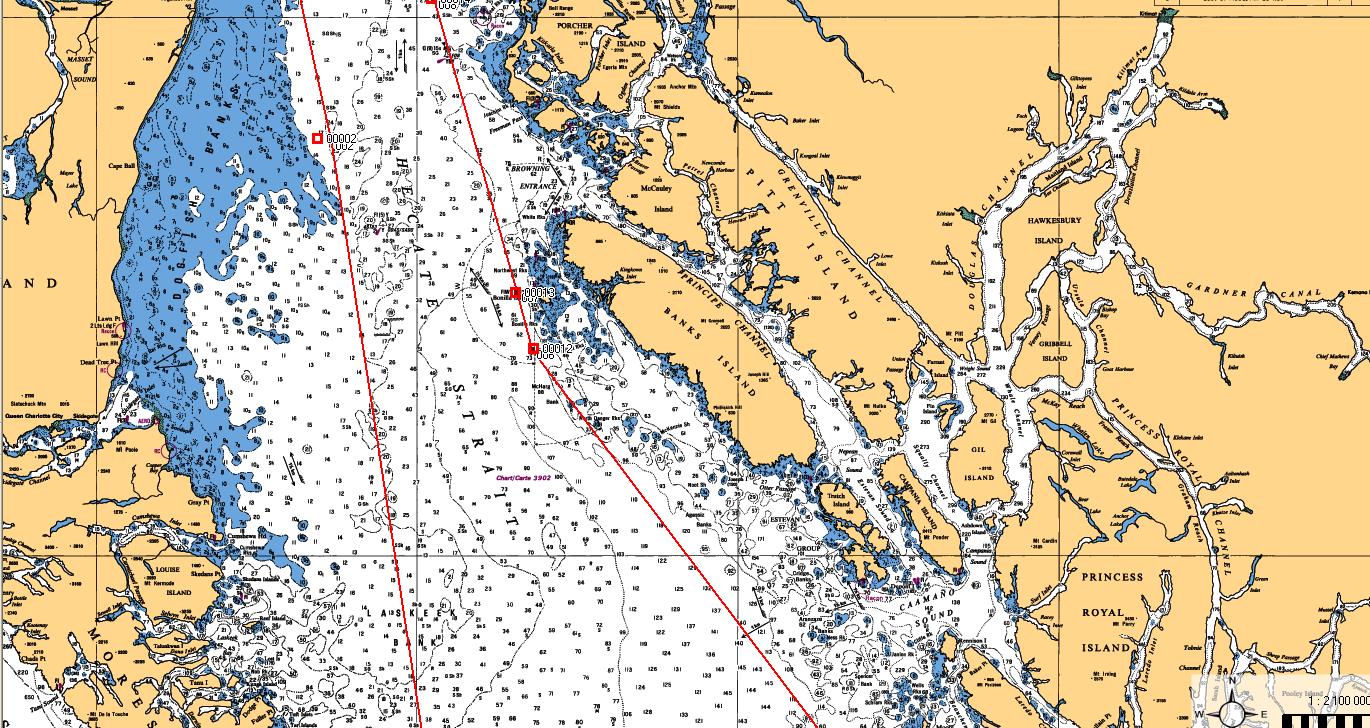
This is simply a larger scale extract of the Hecate Strait CHS chart. (Click to enlarge). You can see the type of difficulty a ship approaching the coast would encounter. For one thing Hecate Strait is world renown for being one nasty stretch of water and boarding a pilot during periods when gale to hurricane force winds are ripping up the place will be anywhere from extremely difficult to life threatening. Additionally, in periods of high winds and high seas, many of the ships expected to approach the coast will encounter a problem developing enough propulsion power to avoid being pushed further shoreward and into some very dangerous shoal ground.

The above is an example of the actual surface weather on 2 April 2012: A mid-latitude depression with an incredible 958 millibar low pressure centre just off the west coast of the Queen Charlotte Islands. Forecast winds north of Vancouver Island and into Hecate Strait were South East at Hurricane Force throughout the morning with seas exceeding 8 meters. With a surface picture like the one above it would constitute a herculean effort for an inbound ship in ballast to maintain adequate control to reach shelter and safe waters. An outbound laden vessel, depending on its size, could easily be set to the north and, if it was exiting Caamano Sound, find itself slamming headlong into the southern extremities of the Queen Charlotte Islands.
There has been much discussion that, in the absence of suitable shore-based radar, the current Automatic Information System (AIS) will provide accurate data on the position, course and speed of any ship in the approaches to either Browning Entrance or Caamano Sound. That would be a temporary fix only. AIS, as useful as it is, is not accurate real-time tracking. Further, it has serious flaws, not the least of which is that vessels often drop off the AIS plot depending on where they are in relation to LOS blocking land masses.

The above is an AIS collection shot. Remarkably, what is missing from this capture is the traffic that was actually present in the inside passages of the central BC coast (3 vessels) and one making a transit across Hecate Strait.
None of this is to say that the Northern Gateway pipeline terminal to Kitimat should or should not proceed. That is not the purpose for now.
It is to point out that the means to ensure complete tanker safety under pilotage and secure vessel traffic management do not yet exist and the recent federal budget is less than comforting.
As pointed out in a previous submission the federal government had this one opportunity to fund and start implementing the required changes to the BC north and central coast to bring shipping safety to a level which will satisfy the need to increase safety and oversight of a massive increase in heavy ship traffic.
The federal government not only did not do anything, it actually cut the budget of the one department responsible for upgrading the vessel traffic services in the critical area. As has been pointed out previously, Enbridge which originally stated that they would be installing new VTS radar and nav aids has made it clear that they have no intention of bearing the cost and are negotiating with the federal government.
None of this is aided by the offerings of Enbridge. This disingenuous bit of propaganda needs to be addressed.
At the link above, Enbridge provides a picture of a chemical tanker arriving in Kitimat on 16 March 2012, and then goes on to provide numbers which demonstrate a continuous flow of tankers between 1982 and 2009, and why don't all you environmental activists just chew on all those wonderful facts.
Well, since I commanded a chemical tanker into the port of Kitimat, I suppose I should clear up some of the fog which the Enbridge spin-merchant has dumped.
Chemical tankers are considerably smaller than the ships Enbridge is proposing to bring to Kitimat. Most chemical tankers max out at about 40,000 DWT.
Enbridge is proposing the following size ships:
AFRAMAX - 120,000 DWT
SUEZMAX - 200,000 DWT
VLCC - 315,000 DWT (eight times the size of a large chemical tanker)
Enbridge, in playing with their numbers (which are accurate) did not provide the annual average numbers. Between 1982 and 2009 there was actually an average of 55 transits of Douglas Channel by tankers annually - somewhere around one ship per week.
Enbridge plans to increase that to about 220 annually, or about 4 to 5 ships per week. And the ships they plan on introducing will be anywhere from three times to eight times the size of existing ships.
Another point, conveniently side-stepped, is that with three LNG terminals in the works at Kitimat, the traffic into Kitimat will actually increase by much more than 220 ships per year. Somewhere on the scale of 400 is much more likely once all terminals are running at capacity.
Enbridge tries to downplay the cargo by suggesting that the current shipping traffic is carrying petroleum products, therefore they are not introducing anything new. Except that they are.
Current and past product into and out of Kitimat was mostly methanol and condensate. Petroleum products they are, but they are actually highly evaporative liquid by-products of natural gas. A spill would cause some immediate damage to be sure, but it would evaporate in short order and there would be little in the way of a persistent effect.
What Enbridge is proposing, (and what they are attempting to favourably compare to a highly evaporative liquid), is actually a liquefied, unrefined, thick crude oil, much more akin to tar than it is to methanol. A spill of that type of product would create lasting devastation for decades - if you could ever get it cleaned up at all.
That brings up the cost of a clean-up, should it ever be required. There is a long and winding road to travel to get both the funding and the resources to deal with a spill. Insurance is a tricky game in the shipping world.
We'll take a look at that next time.
Wednesday, March 7, 2012
54 North and the plan to nowhere (Part II)
Transport Canada claims to have no regulatory problems, at all, with the Enbridge Northern Gateway proposal to bring AFRAMAX, SuezMax and VLCC sized ships into BC coastal waters from the pelagic Pacific.TC submitted their assessment to the joint regulatory panel with no apparent input from sources outside the information provided by the proponent (Enbridge).
Before anyone gets too carried away, what TC actually approved was the proposed plan. In short, TC has no problem with the routes and the route safety proposals offered by Enbridge, provided everything Enbridge is stating in their proposal is actually put into action. That would include markedly improved vessel traffic management, escort and pilot service expansion, spill containment guarantees and stringent terminal safety requirements.
The first, (and most obvious), problem with saying "no problem" is that none of those things actually exist. Some of them require substantial upgrading. Vessel Traffic Services alone are already inadequate north of Cape Caution and, despite initial assurances from Enbridge, to bring them to a condition to properly monitor, assess and manage a high volume of deep-sea ships into constricted waters will require Canadian government involvement on the scale of hundreds of millions of dollars.
The second, (and perhaps more significant), problem is the guidelines on which Transport Canada based their approval.
Transport Canada and Enbridge have engaged in a review of the proposal using the guidance and system checklists in TP743E TERMPOL Review Process (TRP). Given that there is currently little to physically review, any assessment must be non-binding.
Starting with the document itself, a problem arises. The latest iteration of TP743E TERMPOL is dated 2001. That precedes the Canada Shipping Act 2001 by some six years (which did not come into force until 2007). The eleven-year old document is so out-of-date that it doesn't even mention current-day navigation technology, much of which is considered mandatory by the International Maritime Organization.
Equipment such as fitted Automatic Identification Systems (AIS) and Electronic Chart Display and Information Systems (ECDIS) were still in development when TERMPOL was last issued. As a result, such systems are not even mentioned in the review process.
Nautical chart standards have so radically changed in the past decade that TERMPOL does not demand that the latest version of electronic navigation charts, meeting the International Hydrographic Organization S-57 standard, be carried by ships of any tonnage entering Canadian waters.
Perhaps that's just as well since there is no chart meeting the IHO S-57 standard for the critical stretch of Douglas Channel to Kitimat Arm. The only form of electronic display chart available for that area is a raster chart which is little more than a scanned bitmat image of an existing paper chart. While they are accurate enough for small craft, they fall well short of the standard expected in a large merchant vessel.
While many people are trumpeting the TERMPOL review of the Enbridge proposal as some form of regulatory victory, such is simply not the case. A TRP is a highly limited process and the following needs to be understood:
Hopefully we can take a look at the regulatory holes, (some of which are large enough to sail a VLCC through), in a future offering.
Before anyone gets too carried away, what TC actually approved was the proposed plan. In short, TC has no problem with the routes and the route safety proposals offered by Enbridge, provided everything Enbridge is stating in their proposal is actually put into action. That would include markedly improved vessel traffic management, escort and pilot service expansion, spill containment guarantees and stringent terminal safety requirements.
The first, (and most obvious), problem with saying "no problem" is that none of those things actually exist. Some of them require substantial upgrading. Vessel Traffic Services alone are already inadequate north of Cape Caution and, despite initial assurances from Enbridge, to bring them to a condition to properly monitor, assess and manage a high volume of deep-sea ships into constricted waters will require Canadian government involvement on the scale of hundreds of millions of dollars.
The second, (and perhaps more significant), problem is the guidelines on which Transport Canada based their approval.
Transport Canada and Enbridge have engaged in a review of the proposal using the guidance and system checklists in TP743E TERMPOL Review Process (TRP). Given that there is currently little to physically review, any assessment must be non-binding.
Starting with the document itself, a problem arises. The latest iteration of TP743E TERMPOL is dated 2001. That precedes the Canada Shipping Act 2001 by some six years (which did not come into force until 2007). The eleven-year old document is so out-of-date that it doesn't even mention current-day navigation technology, much of which is considered mandatory by the International Maritime Organization.
Equipment such as fitted Automatic Identification Systems (AIS) and Electronic Chart Display and Information Systems (ECDIS) were still in development when TERMPOL was last issued. As a result, such systems are not even mentioned in the review process.
Nautical chart standards have so radically changed in the past decade that TERMPOL does not demand that the latest version of electronic navigation charts, meeting the International Hydrographic Organization S-57 standard, be carried by ships of any tonnage entering Canadian waters.
Perhaps that's just as well since there is no chart meeting the IHO S-57 standard for the critical stretch of Douglas Channel to Kitimat Arm. The only form of electronic display chart available for that area is a raster chart which is little more than a scanned bitmat image of an existing paper chart. While they are accurate enough for small craft, they fall well short of the standard expected in a large merchant vessel.
While many people are trumpeting the TERMPOL review of the Enbridge proposal as some form of regulatory victory, such is simply not the case. A TRP is a highly limited process and the following needs to be understood:
1.4.1 The TRP is not a regulatory instrument. Its provisions, therefore are not mandatory. The TRP’s criteria, however, are used by TCMS in determining the need for making or revising specific regulations, or for implementing special precautionary measures that may affect a ship’s operation within a particular marine terminal system or transshipment site.In short, what that says is that Transport Canada Marine Safety has looked at a very narrow aspect of the entire Enbridge marine proposal. There is still a long row to hoe.
1.4.2 Any report issued by a TERMPOL Review Committee (TRP) should neither be interpreted as a statement of government policy, nor should it be inferred that the government endorses the report in whole, or in part. The report reflects only the judgments of the departmental representatives who reviewed the proposal and prepared the report. Consequently, the conclusions and recommendations presented in a TERMPOL report are not binding on any department, agency, group or individual. Implementation of any recommendation, however, is the prerogative of applicable departmental executives performing regulatory functions or of the proponent, as appropriate.
It must be understood, however, that DFO CCG and TCMS regulatory roles are separate and distinct from their roles in the TRP which is essentially a data and operational review process. The conclusions and recommendations contained in a TERMPOL report do not relieve a proponent from an obligation to fully comply with all applicable legislative and regulatory requirements promulgated, and as amended from time to time, by the various federal and provincial statutes and regulations which apply to shipping safety and to the protection of the environment. These Acts include but are not limited to:
- the Canada Shipping Act;
- the Navigable Waters Protection Act;
- the Arctic Waters Protection Act;
- the Canadian Environmental Protection Act;
- the Canadian Environmental Assessment Act;
- the Transportation of Dangerous Goods Act;
- the Fisheries Act;
- the Oceans Act; and
- the Canada Marine Act.
Hopefully we can take a look at the regulatory holes, (some of which are large enough to sail a VLCC through), in a future offering.
Sunday, February 19, 2012
Two ferry prangs in one week
You might want to file this under, "It can happen to anybody".
 The Caledonian MacBrayne ship Isle of Mull made an extremely hard landing at Oban when it was picked up by a 60 knot gust of wind during her approach.
 Which topped off a bad week for hard landings at CalMac. Another one of their major ships, Caledonian Isles, had a similar problem on Tuesday evening as she was making the approach to Ardrossan.

A CalMac spokesman said: "The MV Isles of Mull came into contact with the pier in Oban as a result of being struck by a 60 knots (70 mph) gust of wind on her approach.
"Her bow visor and the gangway were both damaged as a result. No-one was injured.
"A detailed assessment of the damage will be carried out and once complete we will be able to establish how long repairs are likely to take."

A CalMac spokesman said: "As the MV Caledonian Isles was entering Ardrossan Harbour yesterday evening, the weather deteriorated suddenly and a 55mph (force 9) gust of wind blew her onto the Winton pier.Caledonian MacBrayne is a Scottish state-owned ferry company and it is not without its own share of problems.
"She was tied up while the Master waited for the wind to drop to allow her to berth, which she did about an hour later, and passengers and vehicles were able to disembark. No-one was injured.
"In the interest of safety the vessel is required to enter dock for inspection and repairs, although damage is not believed to be serious.
Sunday, February 12, 2012
54 North and the plan to nowhere (Part 1)
 The proposed Enbridge Northern Gateway pipeline project has already raised more than eyebrows and the hearings have only really just begun. Enbridge has provided assurance after assurance that the whole show will be completely safe including the movement of ships through BC's north coast access to Kitimat arm at the head of Douglas Channel.
 I've made the trip Enbridge is suggesting is completely safe, in a chemical tanker, more than a few times. And given that my ship was considerably smaller than what Enbridge is proposing even my eyebrows started lifting.
Stephen Harper's Feb 2012 visit to China saw him pumping hard to promote the Northern Gateway project. Listening to him it sounded like a fait d'accompli and the regulatory review currently underway is little more than a time-consuming annoyance.
This is the same Stephen Harper who has taken a rake to the funding of federal departments and has forced them to either reduce or cut operations, including the Canadian Coast Guard and DFO, the increased presence of which will be critical to the prevention of any future disaster in light of the enormous expansion in large tanker traffic being proposed.
Enbridge has offered public assurances of a high standard of maritime safety in a summary here. Many of the statements they offer are motherhood:
All vessels entering Kitimat Marine Terminal will be modern and double-hulledAs if they couldn't be? That is a standard of the International Maritime Organization. Enbridge is not doing anything.
Operational safety limits will be established to cover visibility, wind and sea conditionsAgain, not something over which Enbridge has any say. Such limits are established by international rules and Canadian government regulation. Not to mention the standard practice of seafarers. Since Enbridge does not appear to be building a fleet of their own to transport bulk bitumen they will have no additional control over shipping.
The escort tugs will have extensive first response capabilities to provide immediate assistance if required (available to any ship in distress)Good. That bit in brackets however, is not something Enbridge is doing to increase their goodness. It is the statutory obligation of all mariners, when able, to come to the aid of any vessel in distress. This little part of the Enbridge "plan" is written in law.
Northern Gateway will install an advanced radar system to cover important route sections to provide guidance to pilots and all marine traffic on the Northwest coastWill they now? On 16 January 2012, in response to a question posted on the Enbridge website, they said this:
Northern Gateway has had preliminary discussions with the Department of Fisheries and Oceans, Canadian Coast Guard to assess how future additions to aids to navigation and the introduction of land-based radar coverage to the north coast may be paid for, constructed and maintained.
That doesn't sound definitive at all. It sounds like a plan to develop a plan. We'll get back to that a little later on.
Additional navigational aids will be installed, such as navigation beacons, buoys and lights throughout the confined channel areaGiven that this is a DFO/Canadian Coast Guard responsibility the question now rises: who is expected to pay for all these new nav aids? More on that later, too.
Prior to arrival in Canadian waters, all vessels will be vetted by independent, third-party agencies and will be required to meet Northern Gateway's safety and environmental standardsHow very nebulous. In further statements Enbridge introduces a "Tanker Acceptance Program". This is an industry standard and is in place in every major liquid cargo transfer terminal in the world. An old tanker master would look at this statement and immediately think SIRE program from the Oil Companies International Marine Forum. One would expect that Enbridge would be chin deep in the OCIMF library learning how to implement a TAP and develop "best practices" for the safety and environmental standards they are suggesting.
Enbridge, however, is not a member.
Vessel speed will be reduced in the marine channels to between 8 and 12 knotsWhich is one of those kinds of statements that dismisses the reality of conditions. Given the length of the transit and the time involved every ship, in both directions, will encounter changing conditions such as a tide change. Given the range of tide in Douglas Channel, for example (in the 6 meter range), that means a period of maximum flood or ebb currents. The speed over the ground will differ from the speed rung on. At times ships will be carrying revs for more than 12 knots just to maintain that speed. Laden outbound tankers will take time to get up to speed and once there will have a long reach if there is a requirement to slow. The speed of any vessel under pilotage however, may well be determined by the pilot. Ships under escort in Haro Strait and Boundary Passage are not permitted to exceed 10 knots - ever. How does Enbridge propose to see even larger ships permitted to achieve 12 knots when current rules existing in southern waters do not allow it?
All tankers visiting the Kitimat Marine Terminal will be safely guided by certified marine pilotsOne would hope so, since that's the law. I have every confidence in BC Coast Pilots. Recent comments from the president of BC Coast Pilots Ltd. suggested that there would be no problem meeting the demand of increased tanker traffic. I will wonder, until the first transfer has happened, how pilots will join the ship outside the entrance to Caamano Sound in gale or storm force winds. One of the items out of the marine safety video that was interesting is that every ship will have two pilots thus providing the bridge with two more sets of independent eyes.
No.
The requirement for two pilots has to do with watchkeeping needs. The standard practice is that there is always one pilot on the bridge while the other one is resting. On occasion there is a mandatory requirement for two pilots on the bridge under pilotage rules set by the Pacific Pilotage Authority but no such rule exists outside Haro Strait and Boundary Pass at southern Vancouver Island.
At about this point one has to shift over to the marine safety fact sheet to get more information.
All laden tankers in the CCAA will be accompanied by one tug tethered (attached) to the tanker, and a second tug in close escort. Ballasted tankers within the CCAA and all tankers (laden and ballasted) travelling between the pilot boarding stations and the CCAA will be accompanied by one close escort tug.The "CCAA" is an abbreviation for the Confined Channel Assessment Area. That isn't terribly clear on the Northern Gateway public website. Now, as to the escort tugs, let's face one simple fact: there is no legislation regarding escort tugs. Rules governing escort tugs in the waters around southern Vancouver Island come from the Pacific Pilotage Authority - not Transport Canada. And you would be hard pressed to find a copy of any such rules unless you knew where to look. Further, there are several things necessary to make an escort tug useful. There needs to be tanker/tug matching. An escort manual needs to be developed and extensive crew training undertaken. I'll have more on this subject in a future post.
Tankers will be subject to regular Port State inspections by Transport CanadaAs for any foreign-flagged vessel of any type. This is not an Enbridge initiative - it is Canadian law and international maritime convention. The problem here, however, is Transport Canada. Port State Control inspections are anything but transparent and Transport Canada will not make public the result of any inspection without a Freedom of Information Request. Given that the seaworthiness of foreign-flagged vessels in Canadian waters is a matter of public interest in this country, and particularly where it applies to something like a Very Large Crude Carrier (Supertanker), Transport Canada's secrecy around such inspections is an abomination.
Earlier I pointed out that Enbridge stated that they would install land-based radar systems to facilitate traffic management. Since that appeared they have subsequently responded that they were in discussions with DFO and Coast Guard as to who would be funding, constructing and maintaining such a system. In the response they added this:
It is the responsibility of the Canadian Coast Guard, Marine Communications and Traffic Services (MCTS) to monitor traffic in Canadian waters via radio call-in and the newly implemented Automatic Identification System (“AIS”). The introduction of land-based radar with the support of Northern Gateway and proponents of other shipping projects would enhance the ability of MCTS to verify AIS and radio call in data.Right, because there is no marine traffic radar coverage on the north and central BC coast. None. The Marine Communications and Traffic Services of the Canadian Coast Guard has been subject to the same budget cutting measures as all other federal departments. Far from being ready to deal with increased vessel traffic involving ships of up to 320,000 DW tonnes, the Coast Guard is already under stress and the MCTS system has undergone staffing cutbacks.
Enbridge, who originally trumpeted that they would install radar is now appearing to waffle. And they're quite correct - there are other shipping projects for exactly the same area which will see a tripling of traffic into Kitimat. In fact, there are three of them.
If Stephen Harper is such a proponent of the Northern Gateway project and demanding it be built, despite any objections, he'd better be prepared to put his money on the table. The entire central and northern BC vessel traffic management system is need of attention now. If the upcoming federal budget fails to address the requirement to increase vessel safety on a huge scale it is a demonstration that the Harper government is not terribly serious about the Enbridge proposal or it is ignorant of the inherent risks or it just doesn't care. If a complete overhaul of the northern BC vessel traffic system doesn't begin within the next few months, nothing will be ready when the first big honkin' tanker shows up.
There's more, but that should be enough to start you thinking. Part two later.
Thursday, February 9, 2012
A picture that might add to those words from BC Ferries
So, the Queen of Burnaby, fresh out of refit, needs a drydock in a big way.
 That complex looking gizmo, the whole thing, is a cut-away view of a ship's propeller hub.
Ms Marshall is being truthful but perhaps didn't leave those reading her words with the correct impression. The Queen of Burnanby left refit and was put back into service with that critical mechanism not functioning properly.
I'll be watching here.
"Our engineers have determined that the problem with the Queen of Burnaby is in the propeller hub, and that means we do have to drydock the ship in order to facilitate those repairs," said BC Ferries spokesperson Deborah Marshall.The average ferry user could be excused for believing the problem described by Marshall is minor. Until you look at this.
Ms Marshall is being truthful but perhaps didn't leave those reading her words with the correct impression. The Queen of Burnanby left refit and was put back into service with that critical mechanism not functioning properly.
I'll be watching here.
Friday, January 27, 2012
BC Ferry Commissioner Regulatory Review and a single burning hole
I've flipped through the BC Ferry Commissioner's Regulatory Review with some interest. I'll withhold comment for now on a majority of it, although I will suggest that many of the recommendations are a long time coming.
What grabbed me instantly, however, was the graph on page 18 of the report. From 2004 to 2011 the cost of maintenance has been virtually unchanged. That, in an environment where inflation has been driving costs up at a little over 2.3 percent per year.
If BC Ferries was carrying out the same level of fleet and terminal maintenance today that they were before they were flipped over to a profit model the cost of maintenance should have increased. Even if there were efficiencies, it would have been impossible to maintain ships to a high standard of reliability and safety without a scaled increase in maintenance costs.
The first thing to go when a shipping company cheaps out on maintenance is quality control. Inspection falls by the wayside. Small things go unnoticed. Pins are left out and nuts are not torqued down.
What grabbed me instantly, however, was the graph on page 18 of the report. From 2004 to 2011 the cost of maintenance has been virtually unchanged. That, in an environment where inflation has been driving costs up at a little over 2.3 percent per year.
If BC Ferries was carrying out the same level of fleet and terminal maintenance today that they were before they were flipped over to a profit model the cost of maintenance should have increased. Even if there were efficiencies, it would have been impossible to maintain ships to a high standard of reliability and safety without a scaled increase in maintenance costs.
The first thing to go when a shipping company cheaps out on maintenance is quality control. Inspection falls by the wayside. Small things go unnoticed. Pins are left out and nuts are not torqued down.
Saturday, January 21, 2012
Costa Concordia Final Track (Updated 22 Jan)

There are several other simulated tracks floating around which suggest the ship took a course through the rocks. That is unlikely since the ECDIS, ARPAs and echo sounders would have been issuing a series of alarms which, even if silenced by the officer of the watch, would have alerted the bridge to the requirement for an immediate course alteration.
There are a couple of other simulations which have been posted publicly suggesting that there are a pair of East Cardinal Marks on a line of about 315 degrees just to the south of the rocks known as Le Scole which is the suspected point of Costa Concordia touching bottom. A thorough sifting of various lists of lights and buoys and a look though data-bases and S57 charts produces no such aids to navigation in that area.
At the risk of speculating too early, it appears there was an attempt to alter away from Le Scole but that it came too late and the stern was turned into bottom.
Finally, until there is a report from an initial investigation the media feeding frenzy will continue. If any of this is true however, it should serve as a lesson for those few who presume to adopt the characterization of a "rock-star" master. Yes, we all appear on the stage from time to time and introduce the crew. Yes, we have brief interactions with passengers - a quick meet & greet is sufficient. The overwhelming majority of the time, however, is spent ensuring the ship is safe, running smoothly and crew proficiency is on an upward curve.
UPDATE 22/1945 UTC: QPS has updated the Costa Concordia final track. You can watch it here.
Just so you know, this is not the first time Costa Concordia deviated from it passage plan and approved route. Lloyd's List Intelligence tracking shows that the ship made a very similar pass on Islio Giglio on 14 August 2011.
EXCLUSIVE analysis of Lloyd’s List Intelligence tracking data shows that Costa Concordia sailed within 230 m of the coast of Giglio Island on a previous voyage, slightly closer to the shore than where it subsequently hit rocks on Friday.
The cruiseship, which capsized off the Italian coast, had previously changed course to get closer to Giglio on the night of August 14 last year — for La Notte di San Lorenzo, the night of the shooting stars, owners Costa Cruises have said
Speaking at a news conference on Monday, the company’s chief executive officer, Pier Luigi Foschi, stressed that the decision was taken under the authorisation of the local martime authority and the permission of Costa, after the route was reviewed. He also claimed that the vessel was never closer than 500 metres from the coast at any pont in the voyage.
The route taken on January 13, however, was described by Costa Cruises as a deviation from the pre-planned route to make a manoeuvre that was “unauthorised, unapproved and unknown to Costa”.
Both routes passed within a few hundred metres of each other and the tracking data, obtained through Lloyd’s List Intelligence proprietary land based AIS receivers, proves that the vessel would have been less than 200 m away from the point of collision when it took the previously authorised route. The route also took the vessel far closer than the 500 metres claimed by Costa Crociere.
Sunday, January 15, 2012
Let the speculation begin (Passenger Control edition)

And so it should be.
Given the modern era and the regulations under which ships sail, it takes an extraordinary circumstance and extraordinary conditions to put a ship, in transit, into the peril which befell the Costa Concordia.
One of the first issues which arises is the ship's attention to passenger safety management. All passenger conveying companies are required to train their crews in passenger control during an emergency; too many treat it as a mere annoyance. A cost of training which they would otherwise not engage unless forced to do so.
Costa Concordia was meeting the minimum requirement. Her passengers were berthed, settled and at dinner, (in all their dining finery), before they had ever been involved in a passenger muster and boat drill. Their first drill was scheduled for 1700 on the day after they had departed.
That's simply the worst way to present passengers with the method for evacuation and the least likely way to invest the crew in passenger control. The passengers had no idea how to muster and the crew had not gathered in the passenger complement.
Swept up ships never leave that kind of thing to chance. The best way to ensure passengers get a feel for how to participate in their own survival is to conduct a passenger muster and boat drill before the ship departs. That includes lowering boats to the embarkation level so they can see what will happen. If passengers are sitting at dinner joking about the next day's drill and wondering about their fate if something should happen before then, the ship simply hasn't done it properly. Costa Concordia ran square into Murphy's Law.
A good master never stops thinking about Murphy's Law.
When you hit a rock the cruise is over. So is your career, so quit worrying about it.
Under IMO guidance the best life boat is your ship. From all appearances the master of Costa Concordia made every effort to get the ship to a safe port. No fault there. He almost made it. I do question, however, the sense of urgency imparted to the passengers.
Notwithstanding the clear lack of a passenger drill prior to departure, the passengers which have spoken out state that there was confusion. No doubt. There always will be. Some made reference to the Titanic. They always do. So, it makes a great deal of sense to eliminate the fear that thought brings. Complete honesty and a realistic assessment of the situation is imperative. These are not company customers; they are the ship's passengers. They are in the same situation as the crew - except that they have no training. Everyone fears that they will panic. They won't if they have confidence in the people who will ensure their survival. They can't do that unless they know who those people are.
No boat drill. No confidence. Immediate thought? Titanic. I'm going to die. No alarm at the outset of an emergency and a full public announcement of what is known? Panic.
Passenger control? Difficult to achieve. Some will jump in the water. Proof? Costa Concordia.
Yes, I know. They're getting settled and unpacking their belongings and reading the menu and having their first romantic boff. A drill so interferes with their "experience" so early into the voyage.
And in this case, that's exactly what did not happen.
Friday, January 13, 2012
Distress from Costa Concordia (Updated x 3)
Reports are that the 290 meter 114,500 ton cruise ship Costa Concordia has run aground 42 50N 12 50E, on Isola Del Giglio, Italy
More later.
Update 14/0730 UTC: First pictures are coming in. This was sent from Giglio just a few minutes ago.

As you can see, Costa Concordia has rolled over on her side and sunk against the rocks just outside the breakwater at Isola del Giglio. There are various reports that anywhere from 6 to 8 people have perished after the ship struck bottom and ripped a 50 meter gash below the waterline on her port side. Estimates are that 35 people suffered injuries, some of them serious.
First reports are suggesting the ship developed a major electrical fault and may have drifted into reefs outside Porto Giglio. Apparently everyone is now off the vessel.
Giglio news has a webcam here which gives you a view of the harbour and the Concordia wreck. You might have some trouble getting on. It's busy.
Update 14/1725 UTC: The BBC has several video shots of the ship. This first one shows her laying against the rocks. This second set gives you a better picture of the damage. (Scroll down to the 2nd video on that page).

The damage is massive which would indicate this vessel hit bottom with a considerable amount of force. I'm questioning the "electrical fault" which was first announced. From the damage sustained and the location it looks more like the any electrical failure likely occurred post-grounding.
Also, note that the damage is on the port side. The ship rolled over to starboard. That tells a story in itself. More on that later.
Update 14/2045 UTC: Last update before a whole new post on the subject. Take a real hard look at this picture.

Inside that massive tear in the hull is a ROCK. That rock is approximately the same size as the 25 person liferaft hanging in the upper right of the photo. This ship did not drift onto the rocks; it hammered them with enough forward momentum to rip away and embed something a bulldozer would have a tough time moving.
More later.
Update 14/0730 UTC: First pictures are coming in. This was sent from Giglio just a few minutes ago.

As you can see, Costa Concordia has rolled over on her side and sunk against the rocks just outside the breakwater at Isola del Giglio. There are various reports that anywhere from 6 to 8 people have perished after the ship struck bottom and ripped a 50 meter gash below the waterline on her port side. Estimates are that 35 people suffered injuries, some of them serious.
First reports are suggesting the ship developed a major electrical fault and may have drifted into reefs outside Porto Giglio. Apparently everyone is now off the vessel.
Giglio news has a webcam here which gives you a view of the harbour and the Concordia wreck. You might have some trouble getting on. It's busy.
Update 14/1725 UTC: The BBC has several video shots of the ship. This first one shows her laying against the rocks. This second set gives you a better picture of the damage. (Scroll down to the 2nd video on that page).

The damage is massive which would indicate this vessel hit bottom with a considerable amount of force. I'm questioning the "electrical fault" which was first announced. From the damage sustained and the location it looks more like the any electrical failure likely occurred post-grounding.
Also, note that the damage is on the port side. The ship rolled over to starboard. That tells a story in itself. More on that later.
Update 14/2045 UTC: Last update before a whole new post on the subject. Take a real hard look at this picture.

Inside that massive tear in the hull is a ROCK. That rock is approximately the same size as the 25 person liferaft hanging in the upper right of the photo. This ship did not drift onto the rocks; it hammered them with enough forward momentum to rip away and embed something a bulldozer would have a tough time moving.
Spinning more than the propellers
[I was actually working on something new and "tankerish" since it has been my good fortune to have made several trips up Douglas Channel as Chief Mate in nothing less than a chemical tanker carrying condensate. That, however, will have to wait, so check back in the next few days for it. This latest little bit of incident involving a BC Ferry is more immediate.]
 Right now BC Ferries must be feeling a bit beleaguered, not unlike Al Capp's, Joe Btfsplk.
The latest mishap to befall the company is an engineering casualty in MV Queen of Oak Bay. Apparently there was smoke in the engine room and the master quite rightly issued a call for assistance after going to fire stations.
What isn't clear, (and it won't be until an initial investigation is completed), is what actually happened. There are initial reports that the QoOB suffered a crankcase explosion. Subsequently Deborah Marshall, BC Ferries public information person, stated that it was a smoking clutch.
There would be no reason to disbelieve Ms. Marshall's statement if it weren't for one major issue: BC Ferries has been less than sincerely honest when answering public questions. Understandably, BC Ferries would like to mitigate the effect of such mishaps by, perhaps, minimizing them to the point of insignificance. A loss of public confidence in British Columbia's Crown-owned ferry system could create a debilitating effect on ridership especially during the high tourist season.
Now we get further questions because the past obfuscations leave everyone in doubt. Was it a smoking clutch, or was it a crankcase problem? Or would it have been best to simply say, we have not yet isolated the source of the smoke.
And then there's the smoke issue. According to Ms. Marshall:
Ms. Marshall is but the voice of a larger body. That body, however, has been consistent in masking the events surrounding incidents of this nature and the past behaviour of hiding information until they were ordered to submit to FOI requests does nothing to garner public confidence - in either the information nor the system itself.
By way of example, when the Queen of Nanaimo failed to slow on 3 August and hit the berth at Mayne Island it was blamed on the ship picking up a crab trap line and shaking loose a pair of dowels on the port hydraulic distribution box. My chief engineer at the time read the report and said, "Not bloody likely."
Subsequently an internal BC Ferries investigation turned up that the dowels in the port hydraulic distribution box were not properly secured. Vibration, the report concluded, would not have been enough to shake loose the dowels. Crab trap line or not, those dowels were going to work their way loose.
The fact is a more honest approach would be to simply admit to not having enough information to answer immediate questions. And for those questions to which there are clear answers, just answer truthfully. As can be seen from past incidents, when the initial minimizing turns out to be completely false the loss of confidence is immediate and lasting.
I might add that the redactions on page 15 and Appendix B-SOR14 of this report simply generates suspicion when not properly explained.

The latest mishap to befall the company is an engineering casualty in MV Queen of Oak Bay. Apparently there was smoke in the engine room and the master quite rightly issued a call for assistance after going to fire stations.
What isn't clear, (and it won't be until an initial investigation is completed), is what actually happened. There are initial reports that the QoOB suffered a crankcase explosion. Subsequently Deborah Marshall, BC Ferries public information person, stated that it was a smoking clutch.
There would be no reason to disbelieve Ms. Marshall's statement if it weren't for one major issue: BC Ferries has been less than sincerely honest when answering public questions. Understandably, BC Ferries would like to mitigate the effect of such mishaps by, perhaps, minimizing them to the point of insignificance. A loss of public confidence in British Columbia's Crown-owned ferry system could create a debilitating effect on ridership especially during the high tourist season.
Now we get further questions because the past obfuscations leave everyone in doubt. Was it a smoking clutch, or was it a crankcase problem? Or would it have been best to simply say, we have not yet isolated the source of the smoke.
And then there's the smoke issue. According to Ms. Marshall:
It's my understanding the smoke was contained to below the car deckYet according to a passenger:
We could see smoke and some of the employees began getting into firefighting outfits. They started pushing us all to the front of the boat and closed the fire doors to the rest of the boat.Somebody has it wrong. The passenger description suggests that he was in the passenger area, (the presence of fire doors), and that smoke did infiltrate above the car decks.
Ms. Marshall is but the voice of a larger body. That body, however, has been consistent in masking the events surrounding incidents of this nature and the past behaviour of hiding information until they were ordered to submit to FOI requests does nothing to garner public confidence - in either the information nor the system itself.
By way of example, when the Queen of Nanaimo failed to slow on 3 August and hit the berth at Mayne Island it was blamed on the ship picking up a crab trap line and shaking loose a pair of dowels on the port hydraulic distribution box. My chief engineer at the time read the report and said, "Not bloody likely."
Subsequently an internal BC Ferries investigation turned up that the dowels in the port hydraulic distribution box were not properly secured. Vibration, the report concluded, would not have been enough to shake loose the dowels. Crab trap line or not, those dowels were going to work their way loose.
The fact is a more honest approach would be to simply admit to not having enough information to answer immediate questions. And for those questions to which there are clear answers, just answer truthfully. As can be seen from past incidents, when the initial minimizing turns out to be completely false the loss of confidence is immediate and lasting.
I might add that the redactions on page 15 and Appendix B-SOR14 of this report simply generates suspicion when not properly explained.
Saturday, January 7, 2012
The future of BC Ferries: The editorial

McInnes suggests that Hahn's compensation issue was a sideshow. On the surface that may well be true, however, Mr. Hahn often appeared to lack a complete understanding of his position. He should have been aware from the start that his position was not that of a private sector CEO, no more than BC Ferries in the Gordon Campbell restructuring was not a private company.
At one point Hahn responded in an interview that, aside from having to keep travelers appeased, his biggest single customer was the government of British Columbia. True as that statement might be, it demonstrated a failure to acknowledge that his "biggest single customer" got every penny of its money from BC taxpayers and therefore voters.
Saturday, December 31, 2011
Got doors?

Not all rules come out of the International Maritime Organization nor federally regulated maritime administrations. In this case there is a new survey requirement for shell and/or inner doors of both passenger and cargo roll on - roll off ships which comes from the International Association of Classification Societies in the form of a Unified Requirement.
IACS UR Z24 is the new survey requirement for Shell and Inner doors of roll on - roll off ships, both cargo and passenger. (You'll have to scroll down to page 711 of a rather large PDF to get to the details). When this UR first hit table in November 2010 it seemed to refer only to ships fitted with a self-stowed loading ramp. Then a member of the IACS pointed out that "some ro-ro ships are not fitted with a loading ramp, but rather utilize a shore-based ramp since these vessels are on a common trade route." In July 2011, the IACS amended UR Z24 to include all ro-ro and ropax ships with shell doors, (bow, side and stern), leading to a ro-ro deck or special category space.
Generally, this survey requirement is pretty typical although there are some points which might give some operators a few moments of pause:
Door structures, securing, supporting, locking device, welds and sockets are subject to non-destructive testing. The maximum wear allowed beyond as-built thickness is 15 percent.
Door seals will be inspected and water tested. (More on this below).
Hinges, bearings and thrust bearings will be measured and, if not accessible to a surveyor, dismantled to gain access.
Vehicle deck drainage systems with storm valves or non-return valves will have to be dismantled.
The other usual things will also be carried out:
Correct panel lights, including a panel lamp test on all door operating and indicator panels; closed-circuit TV cameras; water leak detection system (if fitted); and, system isolation when not in use.
The following couple of items are going to give a couple of different companies a few moments of grief:
Confirmation that the operating panels are inaccessible to unauthorized persons. (That means denying possible access to all operating panels by people who should not be anywhere near them, such as passengers and uninvolved crew).
Verification that a notice plate giving instructions to the effect that all securing devices are to be closed and locked before leaving harbour is placed at each operating panel and supplemented by warning indicator lights. (That should be self-explanatory but you'd be surprised at how many ropax ships have no such instructions posted).
Weathertight doors
This may be one of the most misunderstood definitions in the ro-ro community. Too often seafarers interpret weathertight to mean "rainproof", and that is simply not the case.
Weathertight doors are required to be able to withstand the most severe maritime conditions when the ship is at sea including pressure from wave action and prevent the ingress of water onto the cargo/vehicle deck. Even in a damaged state, if the door is partially submerged, it is expected to withstand water to a pressure of 0.35 bar (5 lbs per square inch) to a height of 3.5 meters measured from the bottom of the door.
This is where the door seals come into play and the water testing of doors may create some issues. Weathertight doors are expected to keep water off the ro-ro deck under even the most extreme conditions. If any water finds its way through the seals during a hose test there is a very good chance the door does not meet the standard.
Door movement
How many ways can inward opening ro-ro deck doors be described as dangerous?
Of course, you could be like Washington State Ferries and simply not bother with doors at all.

More than scrap value

The two former Albion ferries have been sold to Tidal Towing of Port Coquitlam.
TransLink spokesman Drew Snider confirmed in a news release that Tidal Towing purchased the MV Kulleet and MV Klatawa.
Thursday, December 29, 2011
Too much spin. Not enough fact.
Thanks to On The Waterfront and The Gazeteer we get the semi-informed opinion of British Columbia's GlobalBC (television) chief political reporter. (You might want to read those two blogs first and then come back to what I have to say. Both take the position that the attempt to diminish an uncontrolled crash into the berth is spouting the BC Ferries party line).
I agree, because Mr. Baldry's lack of attention to facts impeaches any other point he might have been trying to make.
As for odds, they aren't a part of the picture in this industry. I am required to navigate something considerably larger than a BC Ferry over or around thousands of rocks safely. If I wish to retain any semblance of my position on the bridge of a ship, I am absolutely required to miss every single one. I do not have, (and no professional mariner has), the luxury of using a ratio of rocks hit to rocks missed to justify a single event of running aground.
I agree, because Mr. Baldry's lack of attention to facts impeaches any other point he might have been trying to make.
Of course, four "hard" landings so far this year seems excessive. But BC Ferries responds that its fleet sails more than 187,000 times a year and averages about a dozen hard landings (of various degrees) a year, which seems to put things in perspective.And what perspective would that be? As OTW pointed out early, this isn't about odds. It's about making sure your passengers are delivered safely to their destination every single time. And, as you can see from her post I linked to at the top, Washington State Ferries, the other large North American ferry operator, is claiming two "hard landings" in two years.
As for odds, they aren't a part of the picture in this industry. I am required to navigate something considerably larger than a BC Ferry over or around thousands of rocks safely. If I wish to retain any semblance of my position on the bridge of a ship, I am absolutely required to miss every single one. I do not have, (and no professional mariner has), the luxury of using a ratio of rocks hit to rocks missed to justify a single event of running aground.
Wednesday, December 28, 2011
About that Assumed Average Weight Per Person thing
Updated below ...
There has been a lot of mirth about the US Coast Guard regulation requiring passenger vessels to alter stability calculations in relation to the "Assumed Average Weight Per Person".
Effective 1 December 2011, the Assumed Average Weight Per Person was increased from 160 lbs. to 185 lbs. The impact on US flagged passenger vessels is significant, particularly smaller types. In Washington State the ferry system declared that (rather than weigh every passenger) they would be reducing their passenger capacity to stay within the stability criteria established for each ship. (I'm not sure about the heeling moment that would occur in a ship like the Puyallup if everyone ran to one side).

It's not just Americans
In fact, during the notification phase the USCG received several submissions. At least two recommended that the AAWPP be increased to 187 lbs., the actual average weight of American adults.
Before anyone starts pointing too quickly at the population of the US there should be some heed paid to decisions by the International Maritime Organization's Maritime Safety Committee. The MSC made amendments to the International Life Saving Appliances code taking effect in October 2010 and then again to take effect 1 January 2012.
Under international rules the former average assumed weight of occupants of lifeboats, liferafts and rescue boats was 75 kg (165 lbs). Effective Oct 2010 the new assumed average weight of all persons, worldwide, getting into a lifeboat became 82.5 kg (182 lbs). As of 1 January 2012 the new mass of 82.5 kg per person applies to all survival craft, worldwide.
Looks like we're all getting fatter.
Good question: From Christina, in comments, about life jackets and whether there have been any changes to match the changes in survival craft. The answer is, YES. Go here for details.
The answer is as follows:
1. For vessels on voyages under 24 hours: 2.5 percent of the total passengers.
2. For vessels on voyages of 24 hours or greater: An approved "infant" lifejacket for every infant onboard.
Infant lifejackets should be marked INFANT.
There has been a lot of mirth about the US Coast Guard regulation requiring passenger vessels to alter stability calculations in relation to the "Assumed Average Weight Per Person".
Effective 1 December 2011, the Assumed Average Weight Per Person was increased from 160 lbs. to 185 lbs. The impact on US flagged passenger vessels is significant, particularly smaller types. In Washington State the ferry system declared that (rather than weigh every passenger) they would be reducing their passenger capacity to stay within the stability criteria established for each ship. (I'm not sure about the heeling moment that would occur in a ship like the Puyallup if everyone ran to one side).

It's not just Americans
In fact, during the notification phase the USCG received several submissions. At least two recommended that the AAWPP be increased to 187 lbs., the actual average weight of American adults.
Before anyone starts pointing too quickly at the population of the US there should be some heed paid to decisions by the International Maritime Organization's Maritime Safety Committee. The MSC made amendments to the International Life Saving Appliances code taking effect in October 2010 and then again to take effect 1 January 2012.
Under international rules the former average assumed weight of occupants of lifeboats, liferafts and rescue boats was 75 kg (165 lbs). Effective Oct 2010 the new assumed average weight of all persons, worldwide, getting into a lifeboat became 82.5 kg (182 lbs). As of 1 January 2012 the new mass of 82.5 kg per person applies to all survival craft, worldwide.
Looks like we're all getting fatter.
Good question: From Christina, in comments, about life jackets and whether there have been any changes to match the changes in survival craft. The answer is, YES. Go here for details.
Update 30/12: The infant lifejacket requirement noted above prompted an offline question: How many?New requirements for the carriage of additional equipment, also effective July 1, 2010,
have been introduced under the SOLAS Convention, as follows:
• On all ships where adult lifejackets are not designed to fit persons weighing up to 140 kg with a chest girth of up to 1,750 mm, suitable accessories are to be provided that allow the lifejacket to be secured to such persons.• All passenger ships are to be provided with lifejackets for “infants”.
The answer is as follows:
1. For vessels on voyages under 24 hours: 2.5 percent of the total passengers.
2. For vessels on voyages of 24 hours or greater: An approved "infant" lifejacket for every infant onboard.
Infant lifejackets should be marked INFANT.
Tuesday, December 27, 2011
High drama off the Antarctic ice shelf
The crew of the 48 meter Russian fishing vessel Sparta have spent the last week struggling to keep their ship upright and afloat.

Luckily, or perhaps just thankfully, there was help nearby and they're no longer on their own. The South Korean ice-breaker Araon has arrived to assist in making repairs and, temporarily at least, bring the fishing vessel's stability condition back to a point where they can make their way to safety.

The question, once the Sparta is safe, is what she was doing there in the first place?
The Sparta was in the Ross Sea off the Antarctic ice shelf fishing for Patagonian Toothfish, a species of sea bass which brings anywhere from US$50 - 60 per kg. In the process of her expedition she struck Antarctic ice and punched a significant hole in her hull well below the waterline. She has a second hole in her bulbous bow which is not expected to prevent her progress to a safe port.
This is "Gold Rush" fishing.
The Sparta is a 24-year old, single-skinned trawler/long-liner. Hardly the class of vessel that should be inhabiting the ice infested waters of the Antarctic. She has liferafts but no lifeboats. In waters that cold liferafts would be near useless. She is a typically underpowered fishing vessel designed for a completely different kind of service. Had the Royal New Zealand Air Force not dropped pumps to her she would likely have sunk and, despite only having a portion of her 180 tonnes of fuel onboard, would have created an unprecedented environmental mess in an area where clean-up would have been near impossible.
She was licensed to fish in the Antarctic closed ecosystem by the Commission on the Conservation of Antarctic Marine Living Resources.

Luckily, or perhaps just thankfully, there was help nearby and they're no longer on their own. The South Korean ice-breaker Araon has arrived to assist in making repairs and, temporarily at least, bring the fishing vessel's stability condition back to a point where they can make their way to safety.

The question, once the Sparta is safe, is what she was doing there in the first place?
The Sparta was in the Ross Sea off the Antarctic ice shelf fishing for Patagonian Toothfish, a species of sea bass which brings anywhere from US$50 - 60 per kg. In the process of her expedition she struck Antarctic ice and punched a significant hole in her hull well below the waterline. She has a second hole in her bulbous bow which is not expected to prevent her progress to a safe port.
This is "Gold Rush" fishing.
She was licensed to fish in the Antarctic closed ecosystem by the Commission on the Conservation of Antarctic Marine Living Resources.
Friday, December 23, 2011
About that awesome ferry crash
Yes, well. The BC Ferries Super C class ships were described by the corporation itself as being awesome. I'm reckoning you know that's not what I mean.
 The 21 December crash into Berth 1 at Duke Point was awesome. And before anybody tries to correct me, 5 knots headlong into the ramp is not a "hard landing"; it's a crash.
Some initial reading
There has been a fairly busy exchange of information going on at On The Waterfront by Vancouver journalist Christina Montgomery. This initial post is merely an expansion of some of the information there and I would recommend reading through the posts and the comments related to the crash of Coastal Inspiration.
Different ship - same gremlin
BC Ferries reports that an electronic failure occurred preventing the pitch control on the drive propeller to respond to bridge controls. That means that this is the second time a Super C has lost pitch control when approaching a berth. Coastal Renaissance experienced something similar two years ago. The difference there was that the ship was well back from the berth and the problem occurred as the ship was supposed to be slowing to make its approach. When the ship failed to slow in response to bridge command it sent senior engineers scrambling and the problem was rectified before the landing was affected.
The decision that saved a few million bucks
The Super Cs are propelled by a diesel-electric machinery system. In simple terms "prime movers" generate electrical propulsion power which is transferred to electric drive motors. In a decision which caused Flensburger Schiffbau-Gesellschaft, (the builder), some concern, the drive motors run at a constant speed turning shafts at either end which mount variable pitch propellers. Speed is controlled by changing the pitch angle of the propeller blades. In transit mode the "forward" propeller is feathered to reduce drag and the ship is driven by the "aft" motor, shaft and propeller. To reduce speed in transit mode the pitch angle on the drive propeller blades is reduced to give it less bite. While this is effective and efficient, the motor, shaft and propeller continue to turn at full speed - and therein lies a problem. If, for any reason, the pitch on the propeller blades does not come off when the controls are worked, the ship will not slow.
FSG was apparently not thrilled with the decision to use constant speed motors. Nor was ABS, the classification society overseeing much of the construction. A better option would have been to install variable frequency drives with cyclo converters or tap converters to control the electrical output to the drive motors and thus be able to control the speed of the drive shaft. If the propeller blade pitch fails to come off when commanded, the shaft speed could be reduced or even stopped thus slowing the ship.
The problem boiled down to dollars and euros. Variable frequency drives would have come in somewhat more expensive and the maintenance requirements for cyclo or tap converters is relatively high. BC Ferries went for the cheaper, much simpler propulsion system.
The kicker here is that BC Ferries knew all about this. In December 2007 BCFS was handed a report prepared by the firm of consulting engineers The Glosten Associates Inc., who were contracted to conduct a due diligence review of the Super C construction. They highlighted an area of concern entitled Propulsion System Reliability and it now appears those concerns were well founded. From that report:
There was considerable discussion at the site regarding the use of constant-speed propulsion motors instead of variable-frequency drives. While the constant speed motors simplify the overall system and eliminate the high maintenance cyclo converters, it results in the propulsion machinery running at full RPM all the time. The primary drawback is at the dock; when the nearly-feathered propeller is rotating at full RPM, any failure in pitch control could have severe consequences. This system has been fully reviewed and completely accepted, so while we do not suggest any physical changes, BCF should fully understand the pitch control reliability and failure modes, and consider including this topic in their vessel training program.
So, save money on simpler propulsion. Spend a lot more rebuilding a destroyed terminal berth.
Added: At least one reader here is interpreting the above incorrectly. Seems to think I believe that the forward system is engaged when the ship is in Transit mode (Mode 1). That is not the case. When the ship reverts to Transit mode from Harbour mode, after switching to Normal, the forward drive motor is disengaged, the shaft is braked and the propeller is feathered to reduce drag. My point, (and the issue pointed out by the surveying engineers), was that the drive propeller, which is nearly-feathered as the ship approaches the berth is running at full RPM. If a pitch control failure occurs the ship is suddenly launched forward.

Some initial reading
There has been a fairly busy exchange of information going on at On The Waterfront by Vancouver journalist Christina Montgomery. This initial post is merely an expansion of some of the information there and I would recommend reading through the posts and the comments related to the crash of Coastal Inspiration.
Different ship - same gremlin
BC Ferries reports that an electronic failure occurred preventing the pitch control on the drive propeller to respond to bridge controls. That means that this is the second time a Super C has lost pitch control when approaching a berth. Coastal Renaissance experienced something similar two years ago. The difference there was that the ship was well back from the berth and the problem occurred as the ship was supposed to be slowing to make its approach. When the ship failed to slow in response to bridge command it sent senior engineers scrambling and the problem was rectified before the landing was affected.
The decision that saved a few million bucks
The Super Cs are propelled by a diesel-electric machinery system. In simple terms "prime movers" generate electrical propulsion power which is transferred to electric drive motors. In a decision which caused Flensburger Schiffbau-Gesellschaft, (the builder), some concern, the drive motors run at a constant speed turning shafts at either end which mount variable pitch propellers. Speed is controlled by changing the pitch angle of the propeller blades. In transit mode the "forward" propeller is feathered to reduce drag and the ship is driven by the "aft" motor, shaft and propeller. To reduce speed in transit mode the pitch angle on the drive propeller blades is reduced to give it less bite. While this is effective and efficient, the motor, shaft and propeller continue to turn at full speed - and therein lies a problem. If, for any reason, the pitch on the propeller blades does not come off when the controls are worked, the ship will not slow.
FSG was apparently not thrilled with the decision to use constant speed motors. Nor was ABS, the classification society overseeing much of the construction. A better option would have been to install variable frequency drives with cyclo converters or tap converters to control the electrical output to the drive motors and thus be able to control the speed of the drive shaft. If the propeller blade pitch fails to come off when commanded, the shaft speed could be reduced or even stopped thus slowing the ship.
The problem boiled down to dollars and euros. Variable frequency drives would have come in somewhat more expensive and the maintenance requirements for cyclo or tap converters is relatively high. BC Ferries went for the cheaper, much simpler propulsion system.
The kicker here is that BC Ferries knew all about this. In December 2007 BCFS was handed a report prepared by the firm of consulting engineers The Glosten Associates Inc., who were contracted to conduct a due diligence review of the Super C construction. They highlighted an area of concern entitled Propulsion System Reliability and it now appears those concerns were well founded. From that report:
There was considerable discussion at the site regarding the use of constant-speed propulsion motors instead of variable-frequency drives. While the constant speed motors simplify the overall system and eliminate the high maintenance cyclo converters, it results in the propulsion machinery running at full RPM all the time. The primary drawback is at the dock; when the nearly-feathered propeller is rotating at full RPM, any failure in pitch control could have severe consequences. This system has been fully reviewed and completely accepted, so while we do not suggest any physical changes, BCF should fully understand the pitch control reliability and failure modes, and consider including this topic in their vessel training program.
So, save money on simpler propulsion. Spend a lot more rebuilding a destroyed terminal berth.
Added: At least one reader here is interpreting the above incorrectly. Seems to think I believe that the forward system is engaged when the ship is in Transit mode (Mode 1). That is not the case. When the ship reverts to Transit mode from Harbour mode, after switching to Normal, the forward drive motor is disengaged, the shaft is braked and the propeller is feathered to reduce drag. My point, (and the issue pointed out by the surveying engineers), was that the drive propeller, which is nearly-feathered as the ship approaches the berth is running at full RPM. If a pitch control failure occurs the ship is suddenly launched forward.
Subscribe to:
Posts (Atom)